
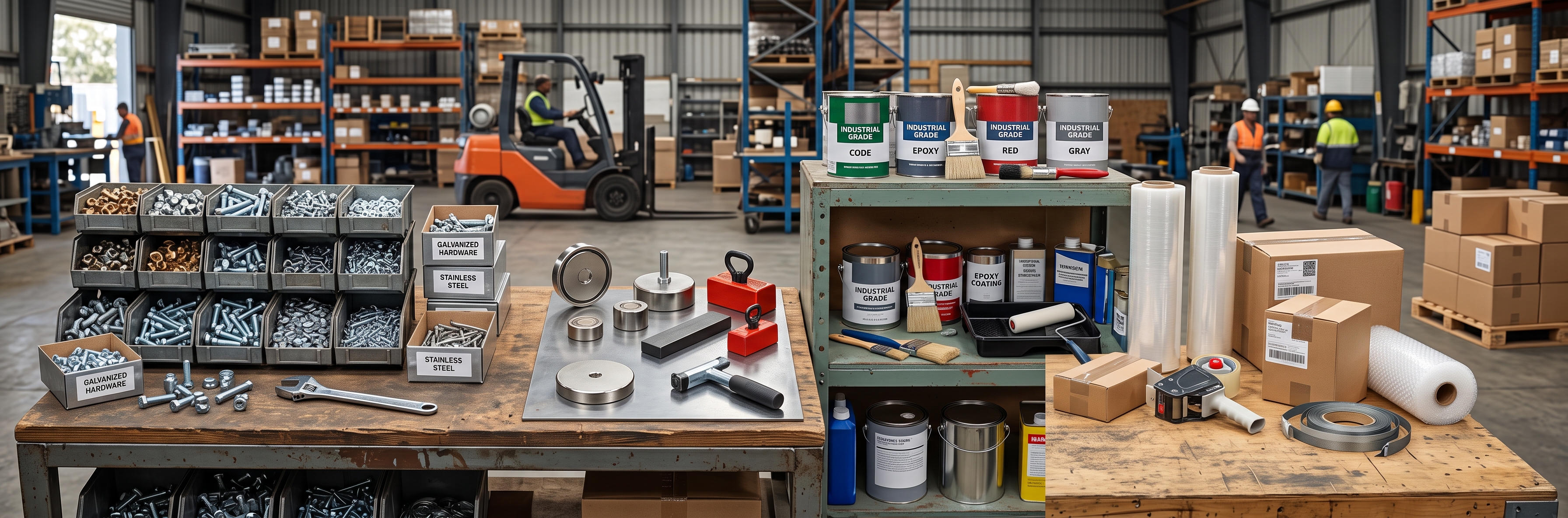
Choosing the right industrial materials can make the difference between a project that performs reliably for years and one that fails within months. Whether you're outfitting a manufacturing line, packaging finished goods for shipment, or designing a product that relies on precise mechanical fastening, the materials you select directly affect cost, durability, and safety.
This guide walks through four essential categories of industrial materials — hook & loop fasteners, packaging supplies, magnets & magnetic materials, and paints — and offers practical guidance on how to choose the right option for your specific application.
Why Material Selection Matters
Every industrial project, regardless of scale, depends on components that work together seamlessly. Selecting materials without understanding their properties, limitations, and best-use scenarios often leads to costly rework, product failures, or compliance issues. A structured approach to material selection considers factors such as environmental exposure, load requirements, regulatory standards, budget constraints, and the expected lifespan of the finished product.
With that framework in mind, let's explore each category in detail.
1. Hook & Loop Fasteners
Hook and loop fasteners, commonly known by the brand name Velcro, have become indispensable across industries ranging from automotive manufacturing to medical devices. Unlike permanent fastening methods such as welding or adhesives, hook and loop systems offer repeated attachment and removal without damaging the underlying material.
Key considerations when selecting hook & loop fasteners:
- Material composition: Nylon hooks paired with polyester loops are common for general-purpose use, while heavy-duty industrial applications may require higher-tensile nylon on both sides for increased holding strength.
- Adhesive backing: Options range from pressure-sensitive adhesive (PSA) for quick application to sew-on variants for textile integration, and even heat-activated adhesives for specialized bonding.
- Environmental resistance: For outdoor or high-moisture environments, look for UV-resistant and mildew-resistant formulations to prevent premature degradation.
- Load capacity: Industrial-grade hook and loop products are rated by shear and peel strength — always match the rating to your application's weight and stress requirements.
Common applications include cable management, securing removable panels, mounting signage, and assembling modular furniture or equipment enclosures. When durability under repeated cycling is critical, investing in a higher-cycle-rated product will reduce long-term replacement costs.
2. Packaging Supplies
Packaging is often treated as an afterthought, but it plays a critical role in protecting products throughout the supply chain, reducing damage claims, and reinforcing brand presentation. The right packaging materials depend heavily on the product being shipped, its fragility, and the shipping conditions it will encounter.
Categories of packaging supplies to evaluate:
- Corrugated boxes and cartons: Available in various wall strengths (single, double, or triple wall) depending on weight and stacking requirements.
- Cushioning materials: Bubble wrap, foam inserts, air pillows, and molded pulp all serve different protective purposes depending on the fragility and shape of the item.
- Tapes and adhesives: Choose between standard packing tape, reinforced filament tape, or water-activated tape based on the sealing strength and tamper-evidence needed.
- Strapping and bundling materials: Polypropylene or polyester strapping secures palletized loads during transit, while stretch film stabilizes mixed loads on pallets.
- Labels and documentation sleeves: Ensure compatibility with your labeling equipment and consider weather-resistant options for outdoor storage or shipment.
When selecting packaging supplies, always weigh sustainability against protection requirements. Many industries are shifting toward recyclable or biodegradable packaging without compromising structural integrity, and this shift is increasingly expected by both regulators and environmentally conscious customers.
3. Magnets & Magnetic Materials
Magnets and magnetic materials serve a surprisingly broad range of industrial purposes, from material handling and separation to sensor technology and product assembly. Selecting the correct magnet type requires understanding the differences in magnetic strength, temperature tolerance, and corrosion resistance across material types.
Common magnet types and their properties:
- Neodymium (NdFeB) magnets: The strongest commercially available permanent magnets, ideal for compact, high-strength applications, though they are more susceptible to corrosion and require protective coatings such as nickel or epoxy.
- Samarium Cobalt (SmCo) magnets: Excellent for high-temperature environments and offer strong corrosion resistance, though they are more brittle and costly than neodymium.
- Ferrite (ceramic) magnets: Cost-effective and corrosion-resistant, but with lower magnetic strength — commonly used in speakers, motors, and holding applications.
- Alnico magnets: Known for high-temperature stability and used in sensors and instrumentation, though they have lower resistance to demagnetization compared to rare-earth options.
Factors to consider when selecting magnetic materials:
- Operating temperature range and thermal stability
- Required pull force and holding strength
- Corrosion exposure and whether coating is necessary
- Space constraints and whether a compact, high-strength magnet is preferable to a larger, lower-cost option
Magnetic materials are frequently used in industrial separators to remove ferrous contaminants from production lines, in magnetic assemblies for product design, and in holding or clamping systems for manufacturing fixtures.
4. Industrial Paints
Paints are far more than a cosmetic finish — in industrial settings, they serve as a critical layer of protection against corrosion, chemical exposure, UV degradation, and mechanical wear. Selecting the right industrial paint requires understanding the substrate, the environment the coated item will face, and the application method available.
Types of industrial paints to consider:
- Epoxy coatings: Highly durable and chemical-resistant, epoxy paints are widely used on floors, tanks, and equipment exposed to harsh chemicals or heavy foot and vehicle traffic.
- Polyurethane paints: Known for excellent UV resistance and gloss retention, making them ideal for outdoor structures, vehicles, and equipment exposed to sunlight.
- Alkyd (oil-based) paints: Offer strong adhesion and a smooth finish, commonly used for machinery and structural steel, though they generally have longer drying times than water-based alternatives.
- Powder coatings: Applied electrostatically and cured under heat, powder coatings provide a highly durable, environmentally friendly finish free of solvents, commonly used on metal furniture, appliances, and automotive parts.
- Zinc-rich primers: Used specifically for corrosion protection on steel structures, offering galvanic protection that extends the life of the underlying metal.
Key factors in selecting industrial paint:
- Substrate compatibility: Metal, wood, and concrete each require different primers and paint formulations for proper adhesion.
- Environmental exposure: Consider UV exposure, humidity, temperature fluctuations, and chemical contact when selecting a coating system.
- Application method: Spray, roller, dip, or electrostatic application each have different material and equipment requirements.
- Regulatory compliance: Many industries must adhere to VOC (volatile organic compound) regulations, so choosing low-VOC or water-based formulations may be necessary depending on your location and industry standards.
- Drying and curing time: Production schedules should account for the time needed for paint to cure fully before the item is handled or put into service.
Selecting the wrong paint system can lead to premature failure, costly reapplication, and even regulatory penalties, so it's worth consulting technical data sheets and, when possible, testing coatings under real-world conditions before committing to a large-scale application.
Frequently Asked Questions
Q: How do I know which hook & loop fastener strength I need for my application?
Match the fastener's rated shear and peel strength to the actual weight and stress the bond will experience, including any dynamic movement or vibration. For heavy or safety-critical applications, always choose a fastener rated above your calculated load to build in a safety margin.
Q: Which magnet type is best for high-temperature environments?
Samarium-cobalt and Alnico magnets generally perform best in high-temperature applications, as neodymium magnets can lose magnetic strength or demagnetize at elevated temperatures unless specifically rated for high-temperature use.
Q: How do I choose between epoxy and polyurethane paint for outdoor equipment?
If UV exposure and long-term gloss retention are priorities, polyurethane is typically the better choice. If the equipment will be exposed to chemicals, abrasion, or heavy wear, epoxy coatings offer superior durability, though they may require a polyurethane topcoat for improved UV resistance.
Bringing It All Together
Selecting the right industrial materials is rarely a one-size-fits-all decision. Each category — hook & loop fasteners, packaging supplies, magnets & magnetic materials, and paints — comes with its own set of performance characteristics, environmental considerations, and cost trade-offs. The most successful projects start with a clear understanding of the operating environment, the mechanical or chemical stresses involved, and the long-term maintenance expectations for the finished product.
Working with knowledgeable suppliers who can provide technical data sheets, sample materials, and application guidance will help ensure that your material choices hold up under real-world conditions. Taking the time to evaluate these factors upfront pays off in reduced downtime, fewer product failures, and a better return on investment over the life of your project.
Looking for high-quality hook & loop fasteners, packaging supplies, magnets, and industrial paints for your next project? Explore our full product range at Krucx to find the right materials for your application.