
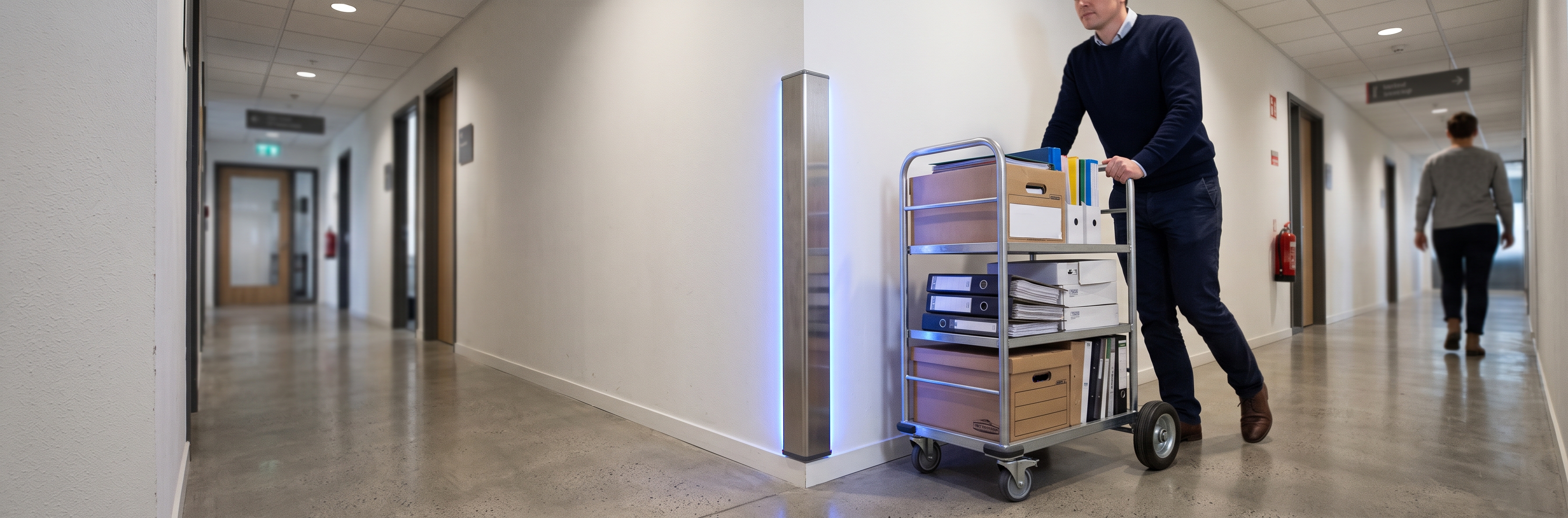
Every wall has a breaking point, and it's almost always the corner. A wheeled cart clips it, a chair bumps it, a suitcase drags past it — and within months, even a freshly painted hallway starts looking tired. What used to be an afterthought in construction and interior design has now become a deliberate design decision: smart wall corner guards.
This post walks through what's driving the shift toward smarter corner protection, the three main types of corner bumpers and wall corner trim available today, and how to pick the right corner armor for your space.
The Hidden Weak Point in Every Room
Corners take more physical abuse than any flat wall surface for a simple structural reason — they protrude. Anything moving through a space is statistically more likely to make contact with a corner than a flat stretch of wall. Over time, that contact adds up to:
- Cracked or chipped drywall
- Scraped and peeling paint
- Exposed corner bead
- A visibly worn, neglected space
This is true in homes, but it's magnified in commercial and institutional settings where foot and equipment traffic is constant. Repainting and drywall repair cycles are expensive, repetitive, and entirely preventable with the right protection strategy.
The Shift Toward Purpose-Built Protection
Wall corner guards used to mean one thing: a plain plastic strip, often mismatched to the wall color, installed purely for function. That's no longer the case. Manufacturers now engineer corner edge protectors around three variables — corner geometry, impact level, and visual integration — which has led to distinct product categories, each solving a different problem rather than one generic solution trying to fit every wall.
The result is a growing market of drywall corner protectors and impact-resistant corner guards built for specific environments, not a one-size-fits-all strip.
1. Equal Wall Corner Protectors — Built for Standard Corners
Equal wall corner protectors are symmetrical on both sides, designed to fit standard 90-degree corners where the adjoining walls meet evenly.
Where they work best:
- Homes, offices, and retail interiors with standard drywall construction
- Hallways, stairwells, and entryways
- Anywhere a clean, symmetrical, low-profile finish is the goal
Why they're the default choice: Most buildings are framed with uniform, symmetrical corners, so equal protectors fit the majority of real-world applications without modification. They install quickly, come in a wide range of materials — PVC, aluminum, high-impact plastic — and blend into standard wall finishes with minimal visual disruption. A PVC corner guard in this category is often the easiest, most budget-friendly entry point for homeowners and property managers alike.
2. Unequal Wall Corner Protectors — Built for Irregular Corners
Not every corner is symmetrical. Older buildings, renovations, and custom architecture frequently produce corners where one wall segment is longer, thicker, or angled differently than the other. Unequal wall corner protectors are asymmetrical by design to accommodate exactly this.
Where they work best:
- Older or renovated structures with non-standard framing
- Custom architectural transitions and angled walls
- Corners where a symmetrical guard would leave gaps or sit unevenly
Why the asymmetry matters: Forcing a symmetrical protector onto an irregular corner creates loose edges and gaps that collect dust, loosen over time, and fail to protect the surface properly. An unequal protector is shaped to match the actual geometry of the corner, which means a tighter fit and longer-lasting protection — making it one of the most reliable custom corner guards for renovated or architecturally unique spaces.
3. Rubber Wall Corner Protectors — Built for Heavy Impact
While equal and unequal protectors are defined by shape, rubber wall corner protectors are defined by material — and that distinction is what makes them suited for an entirely different category of use.
Rubber flexes on impact instead of simply deflecting it, absorbing the force of a collision rather than transferring it straight to the wall. That makes it the material of choice anywhere heavy or repeated contact is a daily reality.
Where they work best:
- Warehouses, loading docks, and industrial facilities
- Hospitals, where beds, wheelchairs, and equipment carts are in constant motion
- Parking garages, stairwells, schools, and gyms
Why durability leads the decision here: Rubber protectors resist cracking under repeated collisions far better than rigid materials, and they're often produced in high-visibility colors like yellow, black, or orange, doubling as a safety cue in industrial environments. They're low-maintenance and easy to clean, which matters in healthcare and food-service settings — though their industrial look means they're usually chosen for function-first environments rather than residential decor. As a heavy-duty wall bumper and industrial corner guard, this category consistently outperforms rigid materials anywhere collision frequency is high.
Matching the Protector to the Space: A Quick Framework
Choosing among the three categories comes down to four practical questions:
- Corner shape: Standard 90-degree corner → equal protector. Irregular or custom corner → unequal protector.
- Impact level: Light residential traffic → PVC or aluminum. Heavy commercial or industrial traffic → rubber.
- Visual priority: Seamless, color-matched finish → equal or unequal in PVC/aluminum. Safety visibility and toughness → rubber in bold colors.
- Installation context: Quick, low-mess installs → equal/unequal PVC or aluminum. Heavy-duty mounting for constant impact → rubber, often adhesive or screw-anchored.
Answering these four questions upfront prevents the most common mistake in corner protection: choosing a product based on price or appearance alone, without accounting for the actual traffic and geometry of the space.
Frequently Asked Questions
Q: Are rubber wall corner protectors better than PVC or aluminum ones?
Not universally better — just suited to different demands. Rubber excels at absorbing heavy, repeated impact in industrial or high-traffic commercial settings. PVC and aluminum are typically better where appearance and a seamless finish matter more, such as in homes or offices.
Q: How can I tell if my corners are equal or unequal?
Measure both wall segments leading into the corner. If they match in width and thickness and meet at a standard 90-degree angle, it's an equal corner. Noticeable differences in measurement or angle mean it's unequal.
Q: Will removing a corner protector damage my paint or wallpaper?
It depends on the mounting method. Adhesive-backed protectors are generally low-residue, but it's a good precaution to test a small, inconspicuous area first, especially on delicate or freshly painted walls.
Q: How long do wall corner protectors typically last?
PVC and aluminum protectors can last for years under normal residential use with proper installation. Rubber protectors are built specifically for durability and can withstand years of constant commercial or industrial traffic.
Conclusion
Corners will always take the brunt of daily wear — that's simply a matter of geometry, not bad luck or bad maintenance. What's changed is that property owners and designers no longer have to accept that damage as inevitable. Whether you're dealing with standard drywall, an oddly angled renovation, or a high-traffic commercial space, there's now a corner protection solution engineered specifically for it.
The real takeaway is this: don't choose a corner guard based on what's cheapest or what looks nice in a catalog photo. Start with your corner's actual shape, your space's traffic level, and how much visual integration matters to you. Get those three things right, and you'll spend far less on repainting, patching, and replacing walls down the line.
If you're ready to protect your space the right way, browse the full range of equal, unequal, and rubber corner guards at Krucx to find the fit that matches your walls — not the other way around.